Showing posts with label Traeger INFO. Show all posts

Sunday, September 11, 2016

My Traeger after 6 + Years

I bought my Traeger 07E from my butcher Kah Meats in 2010.

Yesterday I washed down my Traeger with some simple green. The lid was getting pretty brown but got most of it off. Today applied a coat of mineral oil to it. For being used 6 years it almost looks new. I had sanded down the smoke stack, paint pealed due to operator error and got too hot. The barrel under the lid was corroded some from drips; I sanded it down and repainted it and the stack with some hi-heat Rustoliem. Other than that the rest of the paint is in good shape.

When I bought it in 2010 I joined a forum for pellet smokers and a lot of people were adding fire bricks in the bottom. The thinking was the bricks acted like a heat sink and held temps better especially over long cooks and they would help during cold winter weather. Five of the fire bricks fit into my Traeger, two on each side of the auger tube and one across the end of the fire box. Last summer I took them out and have never put them back in. Did they help, I am not really sure. Last winter I did not note that I burned more pellets without them, but it was a mild winter. Some in more northern areas may find they help.

Most manufacturers sell insulated covers for winter use. I did use a welding blanket the first winter but it was kind of a pain taking off & back on except for long cooks.  I think wind effects heat loss more so than cold weather. In the winter mine is pretty well protected from any wind.

After a couple of years my heat shield got a bad warp and would not set down right. Instead of buying a new one I got 3 steel plates, ¼  X 4 X 12 inches and bolted them to the underside of the shield and it took the warp out. I also get the effect of the steel acting as a heat sink and maybe that’s why I don’t miss the bricks.

I loved cooking on my Traeger and the only complaint was like all had with Traegers; the wild temp swings it would take at times. Mine had the 180 controller on it. Ortech was the manufacturer of the Traeger controllers and came out with one of their own that was supposed to be better than the Traegers so I bought one. For me it was worse than the Traeger controller.

In 2014 I was finally able to buy a Savannah Stocker Controller V.3 from Billy Merrill. It has been great for me; from 180 deg. to 250 deg. it holds usually +- 15 deg. with enough cycles to give out good smoke. At higher temps it will hold +- 10 deg. and usually +-5 deg. After opening the lid sometimes I will get a 20 to 30 deg. overshoot when it tries to recover but will correct itself.

I had problems with burn back, pellets in the auger tube burning; this is usually indicated by smoke coming from the pellet bin. This happened mostly after shutting down. I installed a manual switch so I could run the fan after a shutdown. After a higher heat cook I lower the temp and don’t shut down until I am below 250 deg. The Savannah Stocker has a shutdown mode where it continues to run the fan until it’s below 120 deg.

Most of the new pellet smokers now have PID controllers and are a lot better than the Traeger. Traeger recently updated their controller and now claim they guarantee it to hold temps +- 15 deg. If that holds true it’s not bad. I have not read any reports from new owners.


Not everyone can afford $1200 plus for a smoker so one at $700 is pretty inviting. Another smoker in that price range is the new Camp Chef and they have pretty high quality cooking equipment. 


Sunday, April 10, 2016

Caution: Keep your Fire Pot Clean

Apr 10 2016

Savannahsmoker was just saying he had to clean his fire pot out after 12 hours of cooking on his Blazin Grill Works. I had that in mind since I had done about 5 or 6 cooks on my Traeger and not cleaned it out. I usually do it every 2 or 3 cooks. It was a cold damp 40 deg. today and I thought I am just going to smoke some bologna for an hour, it should be fine.

I had the Traeger at 200 deg. and got the bologna on. I had my Maverick remote inside and was doing other things then noted I was down to 165 deg. It was about 40 minutes in. I went outside to check and it kept going lower so knew I had a flame out. I opened the lid and shut it down; with my Savannah Stoker v3 controller I have to go through a shut down before I can get the hot rod to do a light.

At that low of a temp. it cools down fast with the lid open. If you have caught it in time you can do a relight with success. Well I must have not caught it soon enough and it had dumped too many pellets in the fire pot. I did get a relight but soon the temp was rising fast and got to 300 deg. I thought I better shut it down. By the time I removed the bologna and shut down I was getting smoke from the pellet hopper.

I only had about 2 or 3 lbs. of pellets in the hopper so I emptied them out into a bucket and got it clear of pellets down to the auger. I left the lid open to the pellet bin and the smoker and let it go through shutdown. It shutdown ok and cooled off without getting fire up too much in the auger tube. I will clean it out as soon as I can and run it to clear all the pellets out of the auger tube before adding more pellets and using.

Highonsmoke just said maybe it was the pellets and said he was using Lumberjack pellets. I don’t think it is the pellets but the fire pot and auger feed tube arrangement. If you have a lot of ashes in the bottom then the pellets can build up and cover up the feed tube and that tends to smother the fire. The fire is looking for oxygen and if it can get it through the auger tube it will and burn into the tube. I think about any pellet smoker with a fire pot and an auger feed that feeds directly into the pot you could have this problem.  Not sure but I think the bottom of my auger tube is less than an inch above the bottom of the fire pot.

Prevention is to keep your fire pot cleaned out and you shouldn’t have a problem. Some pellets probably do put out more ashes but the Lumberjack pellets compare well with what Traeger pellets put out. A lot of their pellets are longer and not as uniform as the Traeger pellets and could contribute to a temporary jam at the auger entry and help cause a flame out. But I have had flame outs with the Traeger pellets too. The flame out did not cause the burnback; hat did was a dirty fire pot and too many pellets dumped in before relighting.


Savannahsmoker  and Highonsmoke are members of LTBBQ Forum.

Tuesday, October 8, 2013

Thoughts on my Traeger after Cooking 3 plus years

I have a Traeger 07E and after using for over three years I love this smoker grill. During the second summer I built a small covered deck and cook year around. For safety if you use your smoker or any grill on a wood deck it should be on a fireproof mat or pad. You should also have a class III fire extinguisher close by.

Using the Traeger is like using any other smoker or grill the most important thing is to know your pit. Know how it cooks on all the temperature settings; have knowledge of any hot spots or one side being hotter than the other. I have found my right side is hotter than the left. I have the Traeger 180 deg. controller and I have learned to maintain temps I want.

My RTD, (real temperature device) is located on the center left side and my grill level temps at the center are about 25 deg. hotter than my LED readout. If temperature is important in my cooks I am aware of this. In the smoke mode setting the temperature is determined by the P# settings, P0 thru P9.
P0 is the hottest and P9 is the coolest, I very seldom go above P5; and only use P6 on extreme hot days.
Each P# should vary the temp about 10 deg. A more detailed use of the P#’s should be in your manual or I have an article under INFO here. Ambient temps and wind will have the most effect on maintaining a temperature in the smoke mode. I never let mine get below 160 deg.

At first I had a lot of trouble with large temp swings above and below the set temp and after reading, a lot of people were adding firebricks in the bottom of the pit. They act as a heat sink and do help temp swings some. The Traeger 070 and 07E will hold 5 bricks. After learning more about my pit I only use the firebricks in the winter and remove them in the summer.

In the second year my heat shield warped and would not set flat. To remedy this I bolted ¼ inch plate to the underside and that straightened it out.  This also acts as a heat sink.

I have a hard time maintaining temp settings 180 thru 250 deg. and find I can usually get less temp swings by using the smoke mode and the P# settings. For temp settings of 275 deg. and above I can usually hold within plus or minus 5 deg. I found if you go directly from smoke mode to say 300 deg. you will get a large overshoot; sometimes as high as 50 deg. and then it takes some time to settle down. I found if you ease it up to temp in the 25 deg. increments and let it settle out before going higher, when you reach your desired temp it will only overshoot 5 or 10 deg. I can go from smoke mode and ease up to 300 deg. in about 20 minutes. I usually want my smoker to preheat about a half hour anyway so this does not take any more time or use more pellets.

I have used my Traeger from smoking meats to baking desserts. Anything you can bake in your inside oven you can do on a pellet smoker; they are a convection oven. I have found that with the addition of grill grates I can do some good steaks and burgers. The right side gives good grill marks to steaks and I like to use the back side for burgers that is like using a flat iron grill that browns the burgers all over.

A pellet smoker does not give you an overpowering smoke taste; it’s more like a kiss of smoke and that’s what the wife and I like. For some meats especially pork butts and beef briskets I do like a little more smoke and A-Maze-N Products makes a tube smoker that provides extra smoke. The tube smoker is perforated stainless steel that you fill with pellets, place it in your smoker and light. I have their 12 inch tube and it will provide about 4 hours of smoke.

There are a lot of good pellet smokers out there now to choose from. Traeger started it all and after a few others got into it the Traeger was still the most reasonably priced one. Their quality did suffer after moving their manufacturing process to China. Considering that I think it still is a good smoker for the money.

There are a couple of aftermarket controllers that offer better control for Traeger smokers. One is the Ortech Controls unit, they manufactured the original controllers for Traeger and now offer one that is an upgrade and does a better job of controlling the Traeger. The other one is a Savannah Stoker PID digital controller. Many who have bought the Savannah Stoker rave about it. As long as my controller works I can’t see replacing it but if it ever goes out I will probably get the Savannah Stoker.

After using gas fired water smokers over 25 years, I went through two Master Built, round bullet type and had a Smokey Mountain chest type when I got my Traeger. I love the pellet smoker; it’s so easy to use and clean. I usually clean mine every cook or two. That consists of removing the grate, drip pan, and heat shield and vacuuming out the bottom and burn pot.  I change the foil on the drip pan. All this only takes 10 to 15 minutes. Spring cleanup is just a simple scraping the barrel with a putty knife and vacuuming out. I clean the outside and wipe down with a coat of mineral oil.

Over the 3 plus years of using my Traeger I probably average cooking on it 3 times a week. It is suited to my way I like to cook, almost just set the temp you want and let it cook. I have a Maverick ET 732 remote temp probe. I cook almost all of my meats to internal temperature and can remotely keep track of the meat temp and the pit temp.


This turned out longer than I thought. Just hope there is some good info someone will use. 

Tuesday, September 4, 2012

Install a manual fan switch

Most Traeger owners find that Traeger should have installed a manual switch so the draft inducer fan could be turned on to burn off pellets in the fire pot at the end of a cook. Most like me find that sometimes at the end of a cook, especially after using high heat; they can continue burning back through the pellet auger feed tube after being shut down. Turning the temp down at the end of a cook to the smoke mode for 15 minutes and leaving the lid open after shutting down usually takes care of this.

The first time this happened to me I had smoke coming from under the pellet hopper lid pretty bad. When I realized what was going on I turned it back on smoke mode and let it run until the smoke had stopped coming from the hopper and shut down again. If fire ever got into the pellet hopper you would have a fire that would probably ruin your smoker. Being retired I have the time to sit or keep a close eye on my smoker after shutting down.

After having burn back several times over the two plus years I have had my Traeger I finally installed a manual fan switch.

I bought some 3-wire push connectors and a toggle switch at Lowes for a total cost of $6 US. Now it was just a matter of lying on my back, finding the correct wires and splicing the switch in and drilling a whole for the switch. You will need to tin the wire with some solder for easy insertion into the push connectors.

Traeger’s manual shows the wiring diagram and from it you can see you need to connect to the black wire, coming from the power cord; it comes through a grommet in the sheet metal. The other wire you need to connect to is the orange wire going to a molenex connector where the fan connects. I cut these two wires and tinned the ends after stripping about ¼ inch of insulation.

Caution: You should use a wire stripper when removing the insulation from the wires. Using a knife is not a good choice with these small 18 gauge stranded wires. I have a stripper that does not nick the wires.

The switch I used had wire leads that were already tinned so I just plugged each one into a connector then plugged the two black wires into one and the two orange wires into the other. The switch was rated at 6 amp 125 volts, plenty to handle the induction fan.

You can see a board in the one photo I placed up under and behind where I was drilling my hole to protect the wires. When drilling through thin metal the drill tends to pull in when you break through.

I got to test the switch with today’s cook. After a little over a 5 hour cook I turned the smoker off and the fan on. I left the lid closed at first but then decided it was better to open the lid to burn off the pellets left in the fire pot.

Note: As with any modifications on the site, do so at your own risk. Also if your Traeger is still under warranty; any modifications may void your warranty.


The connectors


Switch with connectors


Board in place for drilling hole


Switch installed


Smokin Don

Sunday, July 29, 2012

Changing the Traeger Hot Rod

My hot rod, igniter, went out a little over a week ago. It opened up instead of shorting so I didn’t blow a fuse, it just failed to light. As soon as I realized it failed I shut it down, took some pellets out and manually lit with a MAAP torch I had handy. I cooked on it twice before I got around to calling Traeger for a new one.

Traeger service was great; I had registered it so they had all my info. Just over 2 years old it was under warranty and the service tech said I’ll get a new one shipped out. He said instructions would come with it & was about a 15 minute job. It was just about a 3 minute conversation. Four days later I had the new hot rod.

The instructions had a nice diagram and looked like an easy job! It may be a 15 minute job if you are younger than 70 and all goes well! I already had the wires disconnected. I removed the 4 screws on the top of the fire pot, tapped it off of the auger tube, twisted it and with some finagling got the fire pot with the hot rod out where I could remove the rod. It is a tight fit.

I removed the set screw that held the rod in place. I could see the end of the hot rod had flared open and would be too large to remove from the tube. I used channel locks to mash it where I thought it would come out ok. This is where the job went into slow down! I got it down to where a steel collar for the set screw was welded to the tube and it would not come out. I cut the wires and took it to my work shop.

I still could not get the rod out or back in the fire pot to work on the end some more. The end of the rod had flared in two sections so I was able to get it back to where there were two ¼ inch holes drilled in the tube. I used a bolt and tapped the flares down the best I could. Then in the vise, twisting, pulling, out of the vise, more twisting, pulling and tapping and a little cursing I finally got the rod out! There were a couple of beer breaks between slow down and removal!

After I got the rod out I could see why it didn’t want to come through the steel collar, it was a smaller diameter then the tube, I guess to keep it centered. Now to get the new rod installed; that was not that easy for me. Being 70 with bifocals and lying on my back is not a good working position! For awhile I thought I would have to remove the pellet hopper and cover; but with finesse and holding the rod just right in it went. A larger hole or an elongated one would make that part easier.

The job went faster at this point! I got the new rod secured and fire pot back in and the rod plugged in. I sprayed my heat shield and drip pan for a little re-seasoning, fired up the grill and went to 350 deg. for awhile. The 15 minute job was about 3 hours for me!

The instructions gave a dimension for the rod to protrude into the fire pot, .125 inches, that’s about 1/8 inch. My old one stuck out there about ½ inches; I don’t know if this made for a faster destruct or not; but I installed the new one per directions. I use my grill 2 to 3 times a week year around so that may be a good life for a hot rod.

I was sure glad that easy job was over! I can now get back to cooking!

Smokin Don

Monday, July 23, 2012

Manual lighting when igniter fails

Igniter failure will be the most common one with your Traeger Smoker. Mine went out the other day after a little over 2 years of heavy use. I use it 2 to 3 times a week even in the winter. Luckily it failed by opening up instead of shorting out so it didn’t blow a fuse.
If you do blow a fuse or trip a GFI unit the first thing to do is find the igniter wires and unplug it and try again.

After waiting too long for mine to light I shut it off, and checked the fire pot it was about half full of fresh pellets. Traegers manual says to use gel lighter fluid to light and after it gets burning turn the smoker on Smoke mode, replace heat shield, drip pan and grate.

I had a MAAP gas torch handy so that’s what I used to light mine. A butane torch might not work as well since they don’t burn as well when held with torch held down. The MAAP torch worked great, the nozzle reaches the fire pot & after about 40 seconds the pellets were burning well.

I manually lit the smoker twice before getting around to calling Traeger service. Traeger is noted for having good service and true to form they were great for me. I had registered my Smoker so they had all my info on record and about 3 minutes on the phone they said we will ship a new igniter!

Two more tips in the photo below, I have a galvanized bucket I use to load pellets. I always have a roll of paper towels out when cooking and after many windy days blowing the towels around I finally said “dummy put them in the bucket”!


Smokin Don

Sunday, July 31, 2011

Leg Braces for Traeger 07E

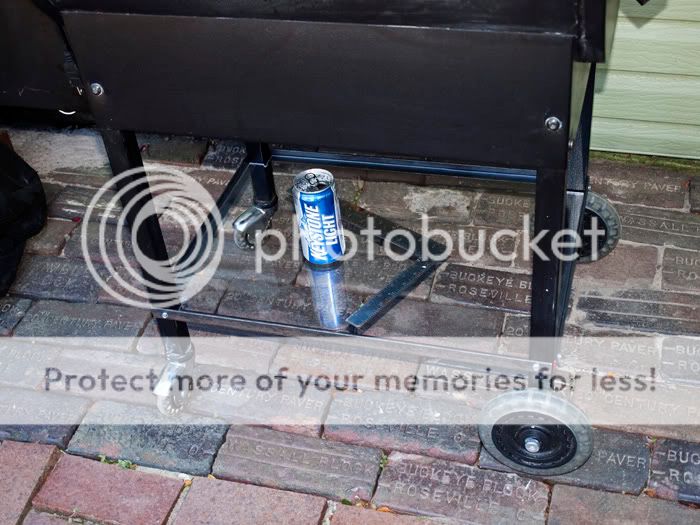
This is an early mod I made to my Traeger. I have to move my grill out from the house when I want to use it. With the extra weight of 5 firebricks was getting worried about the legs coming loose. So I decided to add leg braces like many have. I spent the last two afternoons getting them cut & installed. I used 1/8x3/4 angle iron & plexiglass for the shelf. Probably not the best material but our local Lowes store did not have sheet metal large enough & didn't want to run all over looking for it. Besides it won't rust! As much as I like Lowes that's the problem, our two Hardwares we used to have closed up, they would have had the sheetmetal. I used #8 self drilling sheet metal screws, maybe a size too small but I can always go bigger. I used clamps to line up the angle iron & used a pilot drill through the angle iron into the leg & then drilled the holes in the angle iron bigger for the screws. Photo next, I added a couple items to the shelf so you can see it's there.
One tip is I offset the screws on each leg L&R so they would not butt up in the center & interfere with each other.

Material needed:
4 pieces of angle iron
1 sheet shelf material
self drilling sheet metal screws
hack saw for cutting angle iron
drill & driver for screws
square
saw to cut shelf material
& if your like me about a 12 pack

Monday, July 11, 2011

Adding a Second Shelf

I got this idea from Savannah Smoker on pelletheads forum. It will be nice for added room on large cooks. Mar 18, 2011 Snows gone, took my longjohns off, birds are chirping & building nests, & a nice 60+ yesterday so decided to give my 07E a spring cleaning & add the extra shelf I had bought this winter. I was inspired by Savannahsmoker but was in a stew about how to hold the angle iron in place to drill the holes. I measured just below the stack & found 17" was good for the length. Used 1/8 X 1 1/2" angle iron, 2 allen button head 1/4" bolts, nuts & lock washers. I predrilled the angle iron 2" in from the end, centered w/7/16 bit. I notched the one to accommodate temp probe. I came up with a block of wood 4 1/4" long to support the back of angle iron above the existing shelf support, used a c clamp w/a folded piece of sandpaper to protect the paint. I drilled the front hole first w/ 1/4" drill thru the angle iron then inserted bolt while I drilled the back hole. This worked well to hold the angle even. It should only take some a couple hrs but this ole man took all afternoon to clean, cut & drill the angle, & mount, plus at least a six pack! Smokin Don
A second thought would be to use 1 3/4" or 2" angle iron. It would be easier to get the shelf to fit in past the end lips. I had to cut my shelf a little longer than the opening, so it would not slide off & takes a little finessing to get in & out. Photos below.

Note: As with any modifications on the site, do so at your own risk. Also if your Traeger is still under warranty; any modifications may void your warranty.


Heat shield Mod

After about a year of using my Traeger I found the heat shield, or deflector, had warped some & did not set level. Looking at a lot of mods for a heatdeflector, some made heavier ones, some added a cast iron griddle. You can also buy a stainless steel one as well as other parts at pelletgrill outlet.com but they are expensive. My stock heat deflector had warped some & I was thinking about adding a cast iron griddle. I could not find a griddle & then thought if Lowes has some heavy, ar least 1/4" steel large enough I will just add that. They had some 1/4X4X12" pieces so bought 3 & some bolts & locking nuts. I predrilled the plates & bolted them to the underside & the heat shield. I had thought maybe I could take the warp out before I bolted the plates in place but the warp would just spring opposite when I tried. When I bolted the first plate on the warp came right out & after all in place it sat level. One piece 1/4X12X12" would be better than my 3 pieces but that is all I could find handy. I just sprayed with pam & burnt in on Hi. Photos below.

Note: As with any modifications on the site, do so at your own risk. Also if your Traeger is still under warranty; any modifications may void your warranty.


Traeger Modification

Early I learned from forums most Traeger owners add fire bricks in the bottom. You can buy them at any brick supplier. It is best & safer to use fire bricks than any other type. These act like a heat sink and help maintain temps. This also equals less pellet burn. My Traeger 07E will hold 5 fire bricks as pictured below & I think they really help.

Note: As with any modifications on the site, do so at your own risk. Also if your Traeger is still under warranty; any modifications may void your warranty.

INFO: Traeger Operation

If you own a Traeger Smoker you need to know how it operates. The oldest controller they used just had a Low, Med, & High setting. Then they came out with a 225 controller w/digital readout, it had a Smoke setting then a 225 deg & up in 25 deg. increments to High. It also had P settings to control the smoke mode, or run idle time. Ambient temps affect the smoker so they had the P settings to offset this. There were settings P1 thru P12, on P1 the pellet feed auger ran for 15 seconds then off for 45 seconds. Then higher P settings incremented the off time + 10 seconds, the feed time always is at 15 seconds on. Then if you go to a higher setting the pellet feed auger runs continuous until that temp. is reached, then it would fall back to the smoke, idle run time until it fell 3 deg below the set temp then continuous until set temp was reached again etc. I think with the 225 controller you could only access the P settings from the back of the controller to change them. People had a lot of trouble with high temp swings & they found when it fell back to the idle run time it started with the 15 seconds on time. So they designed a new controller to start with the programmed off time, after it reached set temp. & they added a 180 deg setting & also made access to the P settings thru a small hole on the front of the controller. I use a small allen wrench to change them.

P setting examples:
P1 auger on 15 seconds auger off 45 seconds
P2 auger on 15 seconds auger off 55 seconds
P3 auger on 15 seconds auger off 65 seconds
Each increment of the P# up or down should change the temp about + - 10 deg

A lot of owners prefer to control cooking temps below 300 deg. by leaving it in smoke mode & just using the P settings. I prefer to get mine to holding temps in the smoke mode just below the set temp I want to cook at, this way I don’t get many wild temp swings. For example if I want to cook at 225 deg I get it running about 200 deg in the smoke mode then go to 225 deg. If you use the 180 deg setting you want to make sure it is running below 180 deg in the smoke mode. I only use the 180 deg setting for long smoke cooks like a pork butt or brisket where I don’t want to have to monitor the smoker much. If you try to do it on smoke mode you stand the chance of going below 160 deg & have a flame out if ambient temps change. I know for the novice this may sound complicated but after you use your Traeger awhile it is pretty simple. Some of the newer smokers control the temps better than the Traeger without ambient temps affecting them but you will not buy them for $700, more like double that or more.
Always shutdown your smoker w/the lid open. If you don’t you stand a chance of burn back thru the auger tube, from the fire seeking oxygen to burn up what pellets are left. If the last part of your cook was over 300 deg it’s a good idea to turn down to smoke mode for awhile before shutting down. I usually wait until it’s below 250 deg.